Short horizontal black line on a white background

UTILITY LINE CLEARANCE
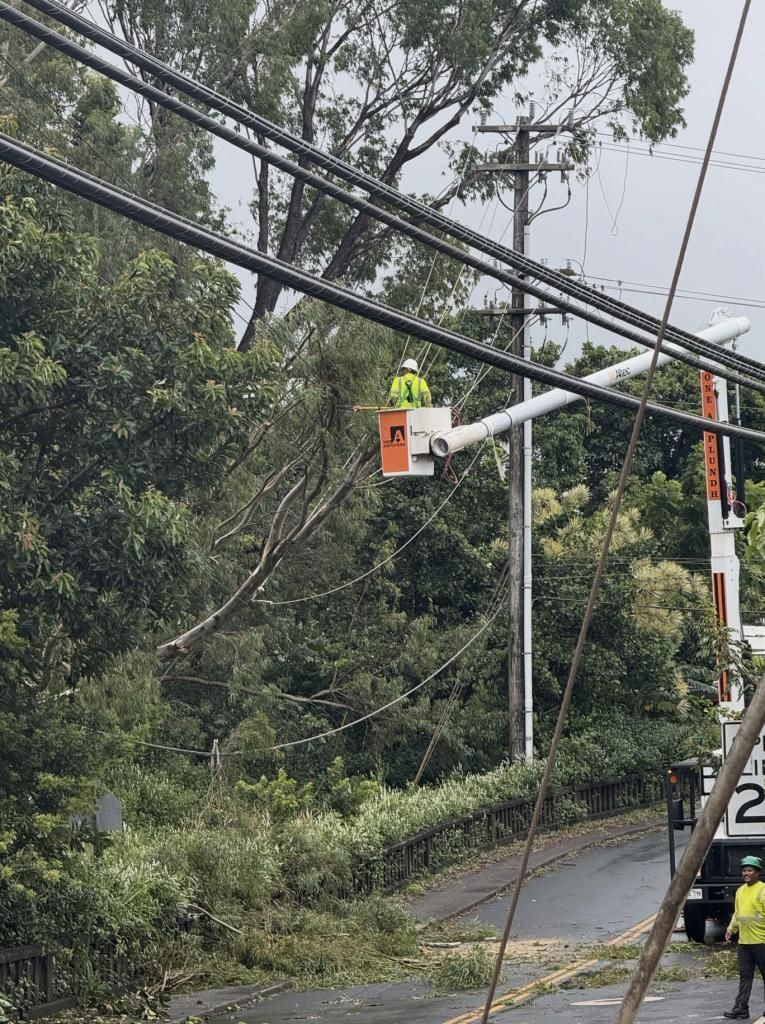
The line running from the pole to your house is generally the property owner's responsibility, while the utility maintains its own distribution conductors and will clear vegetation touching them. That split is where most confusion starts. Tree State Property Maintenance handles utility line clearance in Trainer, PA around service drops, communication lines, and site lighting, always after a hazard assessment and, where required, coordination with the utility. Licensed, insured, and available around the clock when a limb lands on a line.
Two workers in hard hats crouch on a rooftop, working on the roof structure under a cloudy sky.
Person carrying wooden planks on a rooftop under a blue sky

THE UTILITY HANDLES ITS WIRES. THE REST IS YOURS.

The distribution lines running pole to pole belong to the utility, and it prunes around them on its own cycle. The drop crossing your yard to the meter, the cable and phone lines beside it, and the trees growing into all of them are a different matter, and they are usually the ones brushing a roof or arcing in a storm. We assess which category a given problem falls into and tell you plainly who should be doing what, before anybody quotes work that is not ours to do. Half of these calls end with a phone number for the utility.

✓ Hazard assessment before any pruning

✓ Utility contacted where coordination is required

✓ No work on energized conductors

✓ Clearance restored on the customer side

Black horizontal line on a white background
UTILITY LINE CLEARANCE
WIRES AND WOOD DO NOT NEGOTIATE.
Electricity does not need contact to be dangerous; it will arc across a gap to a wet branch or a conductive tool. That is why line clearance is a planned operation rather than a ladder and a pole saw on a Saturday. Approach distances, de-energization, insulated equipment, and utility notification all exist because the alternative has killed people who were competent at every other part of tree work.
OVERHEAD SERVICE IS STILL THE NORM IN THESE BOROUGHS.
Most of the housing around here was wired long before anything went underground, so poles, drops, and communication lines run right through the same canopies that have been growing for 60 years. Add narrow rear yards, shared alleys, and mature street trees and you get contact points on almost every block, which is why this work comes up here far more often than the average.
NOBODY LEARNS LINE CLEARANCE IN A WEEKEND.
Judging clearance distances, recognizing a service drop from a primary conductor, knowing when a job stops and a phone call to the utility starts: none of that is guesswork, and none of it is optional. 10 years of working in this county has taught us where the line sits between what we can safely do and what needs the utility on site first. We would rather lose the job than get that wrong.
WHY CHOOSE US FOR UTILITY LINE CLEARANCE.
An Honest Answer On Whose Job It Is
Some of what people call us about is genuinely the utility's responsibility and costs you nothing. You get told that plainly, with the reasoning, rather than being quoted for work the power company would have come out and done.
Assessment Before Anybody Climbs
Every job starts with identifying what the lines are, what they carry, how close the growth is, and what condition the tree is in. Nothing is cut until that picture is complete and the approach has been decided.
Coordination Handled Properly
Where the situation calls for the utility to be notified, de-energize a span, or attend the site, that gets arranged before a date is set. Skipping the step is faster and it is exactly how people get hurt.
Clearance That Lasts A Season Or More
Cuts are placed so regrowth heads away from the conductors rather than straight back into them. Directional pruning takes slightly longer and means you are not looking at the same branch on the same wire again next year.
The Right Equipment For The Setting
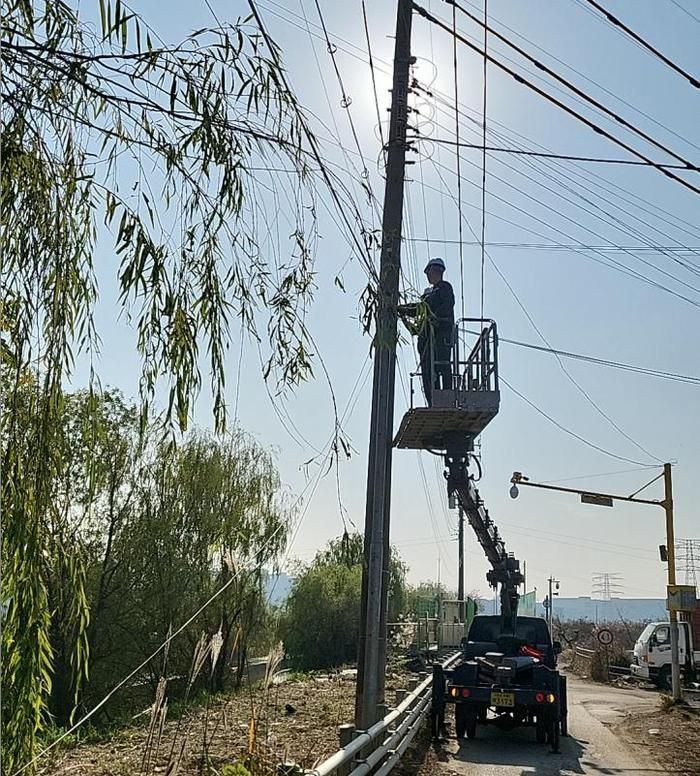
Insulated tools, bucket access, and rigging over an energized span are not optional extras in this work. Bringing them as standard is what allows the job to be done at a safe distance rather than an approximate one.
Storm Calls Answered Around The Clock
Limbs land on lines at the worst hours. A 24/7 number means you get advice immediately about what to keep clear and who to report the line to, and a crew as soon as it is safe for one to work.
Thin black horizontal line on a white background

our services

OUR UTILITY LINE CLEARANCE WORK
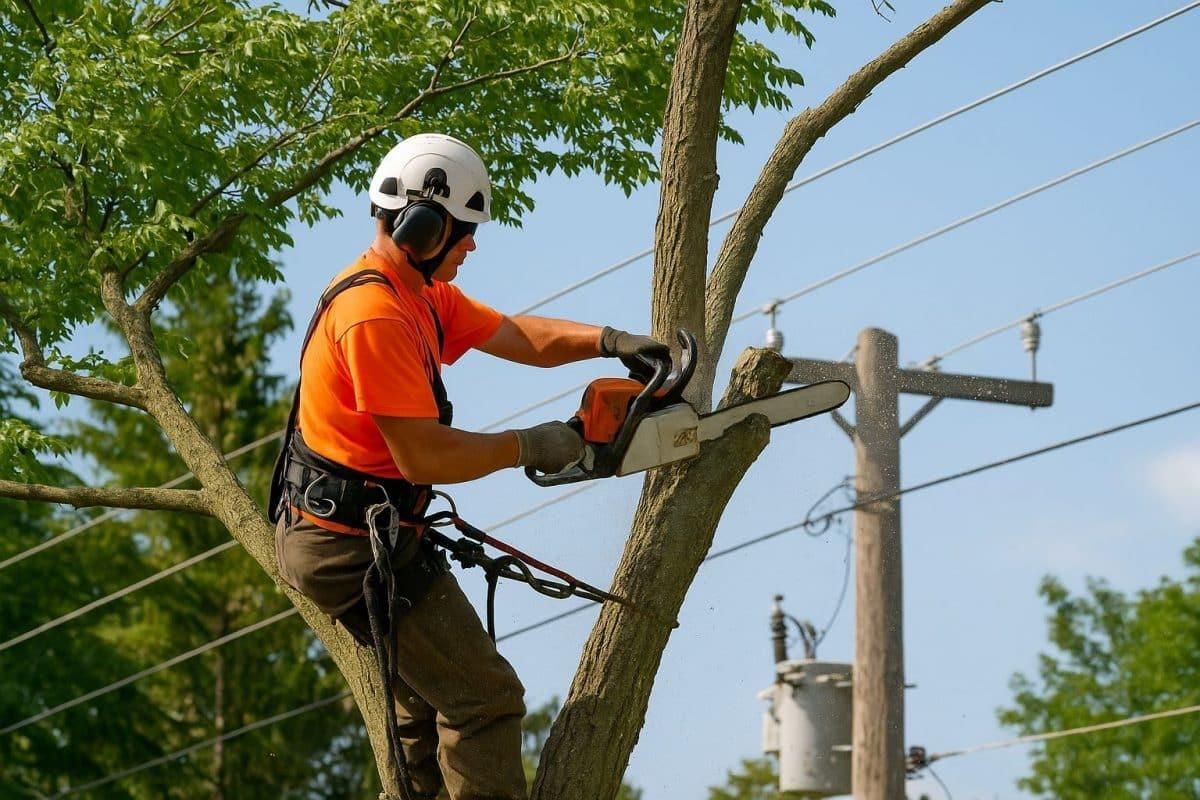
Line clearance covers more than power. Communication cables, site lighting, and the trees threatening any of them all need the same planned approach, and the answers differ by what the line actually is.
Person carrying wooden planks on a rooftop under a blue sky
SERVICE DROPS
Service Drop Clearance Pruning

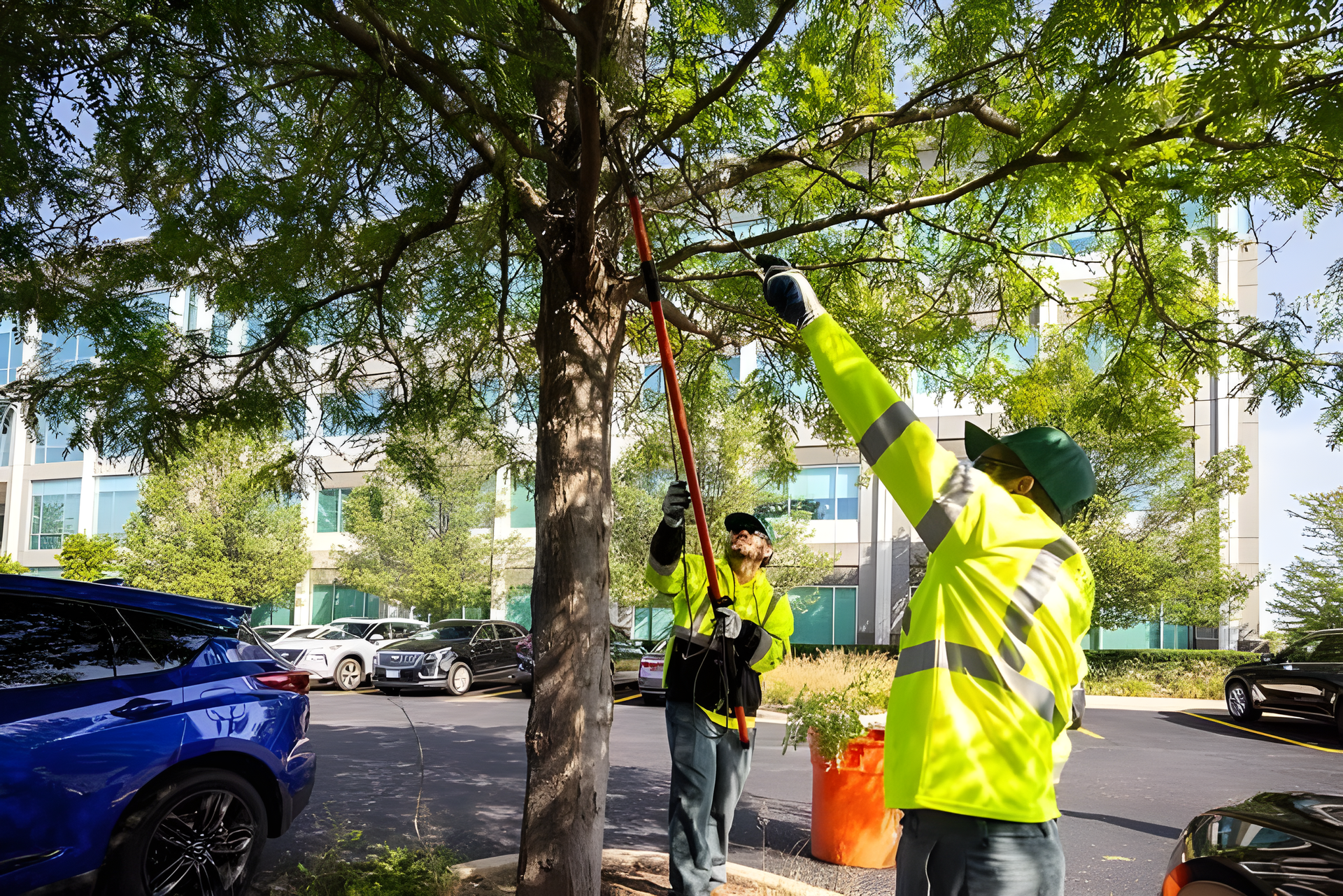
The span from the pole to the weatherhead is the contact point we see most often. Growth is pruned back and directed away from the drop so branches stop rubbing insulation and stop loading the line in wind.
Two workers in hard hats repairing a shingled roof under a cloudy sky.
LOW VOLTAGE
Communication and Cable Line Clearance

Phone, cable, and fiber runs sit lower than power and get swallowed by growth quickly. Clearing around them removes a nuisance outage risk and stops branches from tearing the hardware off the side of a building. Both are avoidable.
Two roofers wearing hard hats work on a shingled roof, one kneeling and one leaning forward.
SITE LIGHTING
Lighting and Pole Clearance

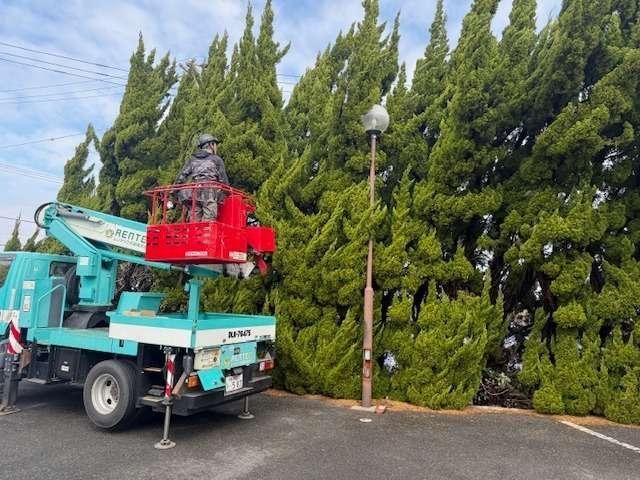
Canopy growing over pole lights and parking lot fixtures kills the coverage those fixtures were installed for. Pruning restores the throw of the light without leaving the tree looking cut back to a flat face. Coverage returns without the tree being ruined.
House roof with steam or smoke rising from a damaged section near the gutter
HAZARD TREES
Hazard Tree Removal Near Lines

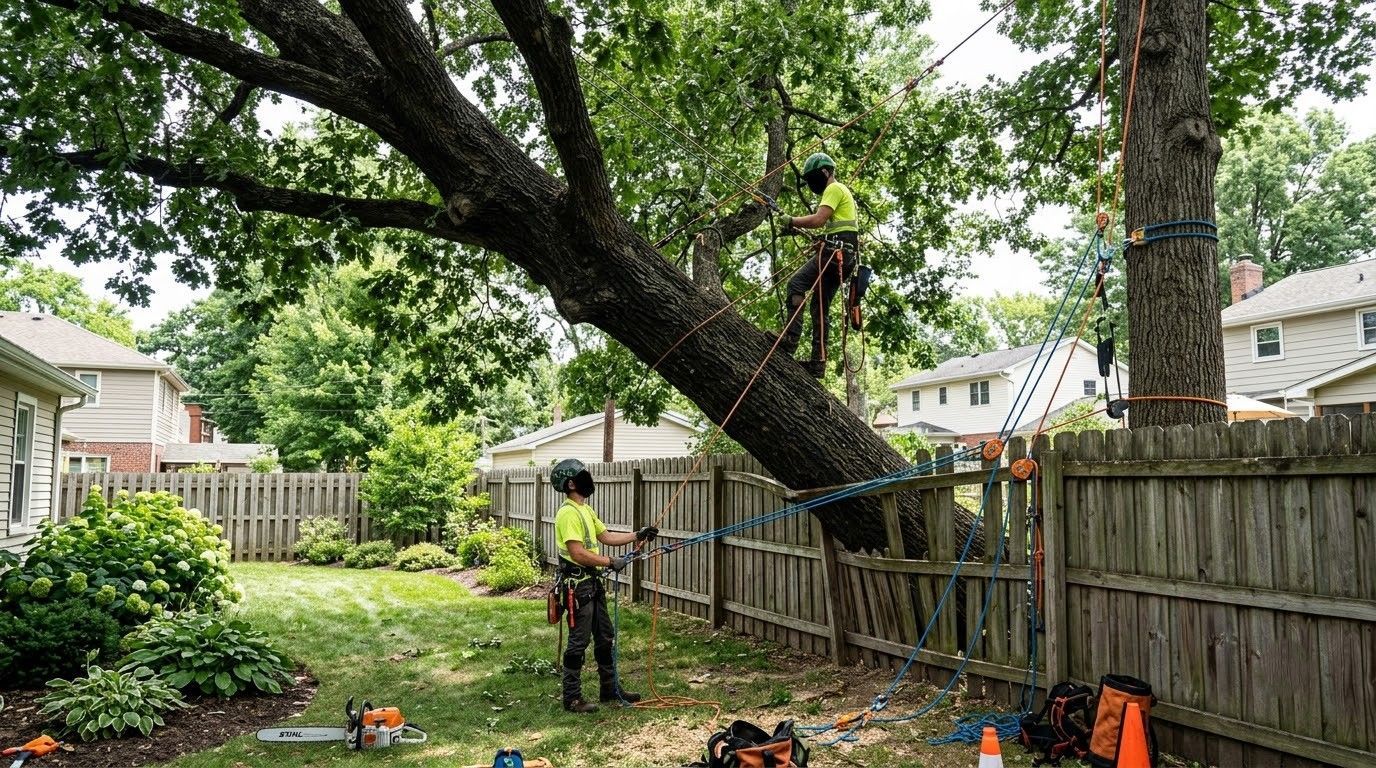
A dead or failing tree within falling distance of a line is a scheduled outage waiting to happen. These are assessed, coordinated where required, and taken down in sections rather than felled anywhere near the span at all.
Two workers on a shingled roof, one kneeling with a hammer and one sitting nearby under a cloudy sky
RIGHT OF WAY
Right-of-Way and Access Clearing

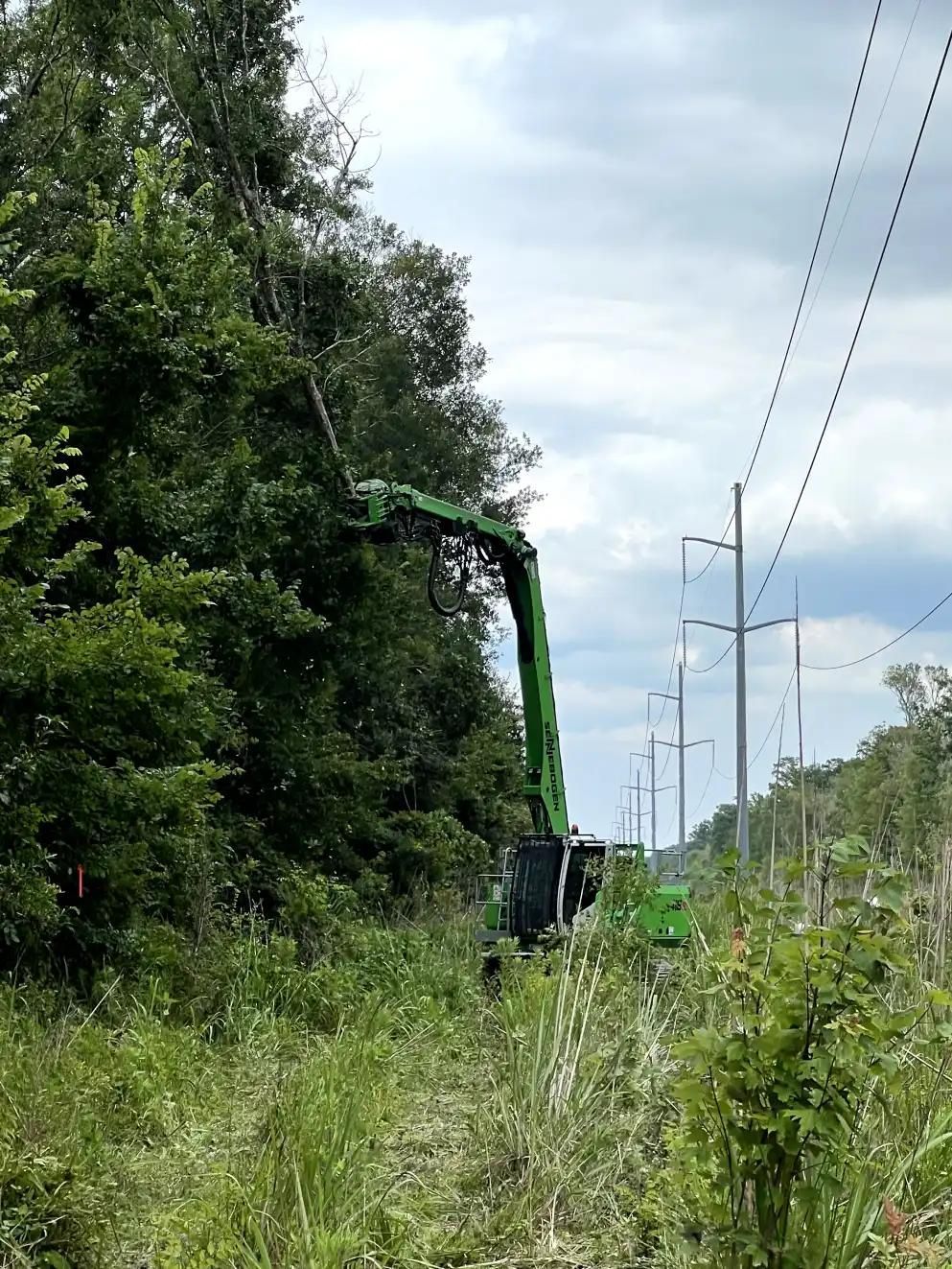
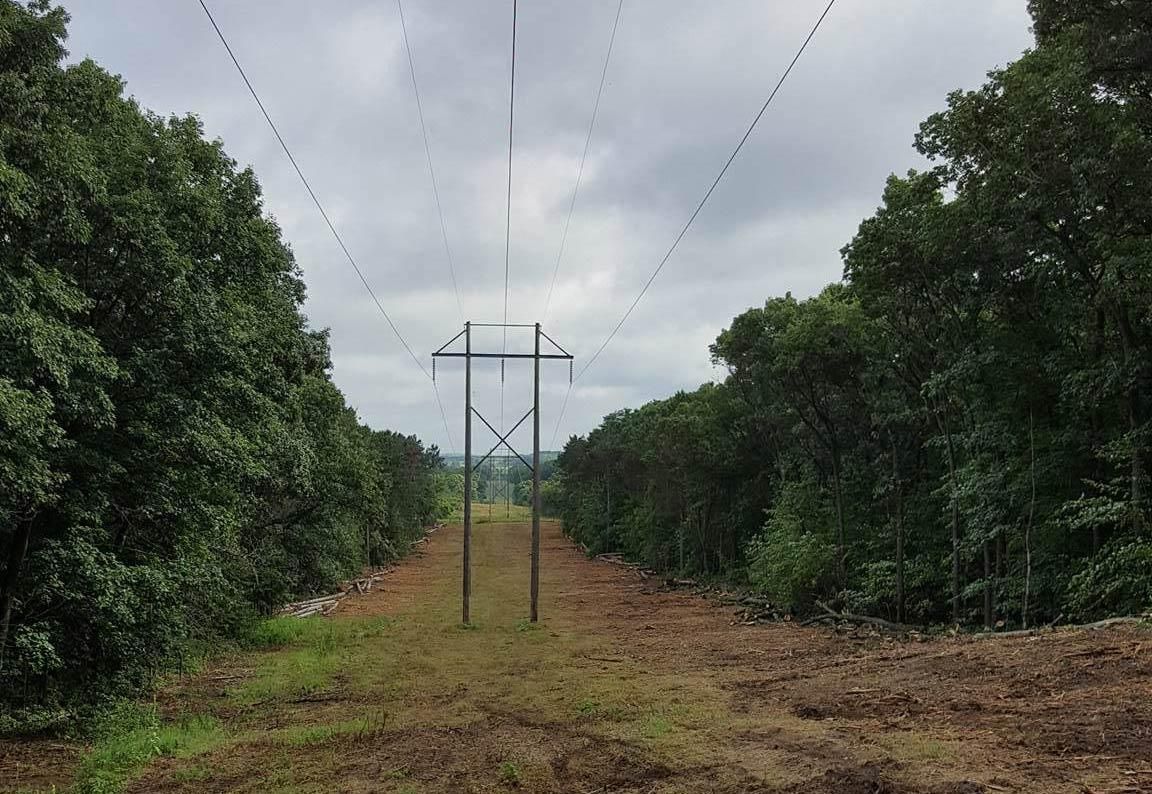
Utility easements, service corridors, and access lanes grow closed faster than most owners expect. Clearing them back to the required width keeps crews able to reach equipment and reduces the number of contact points along the whole run.
Snow-covered rooftops under a clear blue sky
STORM WORK
Storm Response Around Lines

After a storm, limbs resting on spans need careful handling and often a utility crew first. We assess, report what needs reporting, and clear the vegetation side once the line has been confirmed safe to work near. Never before that.
Black horizontal line on a white background

Real Reviews · Real Customers

WHAT OUR CLIENTS SAY.

The reviews on this work tend to mention the conversation more than the cutting. People remember being told which parts were the utility's problem and which were theirs, and that nobody tried to sell them the difference. Read what they wrote.
Black horizontal line on a white background
Common Questions
FREQUENTLY ASKED QUESTIONS.
Common questions about trees, power lines, and communication cables, including who owns which span, how much clearance is enough, and what the utility will and will not handle.

Who is responsible for the line running from the pole to my house?

That span is the service drop, and responsibility for vegetation around it typically sits with the property owner rather than the utility. Utilities generally maintain clearance on their own distribution conductors between poles instead, not on the customer side.


How far should branches be kept from overhead electrical lines?

Enough that no growth can contact a conductor in wind or under snow load, which usually means several feet rather than inches. Never judge that distance from the ground, and never assume a line is insulated because it looks covered.


Does the utility company trim trees near power lines for free?

For vegetation contacting its own lines, generally yes, on a maintenance cycle or on report. Work on the customer-owned service drop, on communication lines, or on a tree that simply needs pruning is usually not covered by that program.


What exactly is a service drop?

It is the overhead span carrying power from the utility pole to the attachment point on your building. It is lower than the distribution lines, it crosses your property, and it is the one most likely to be in a tree.


Can trees be planted underneath power lines?

Only low-growing species. Anything that matures above roughly 25 feet will eventually reach the conductors and be pruned into an awkward shape for the rest of its life. Choosing the right species at planting avoids the whole problem.


Why does utility pruning leave trees such an unusual shape?

Directional pruning removes whole branches heading toward the conductors instead of shortening them, which produces a V or L shape. It looks severe but it is structurally sounder than repeated stubbing and keeps regrowth away from the wires.


What should be done about a tree touching a cable or phone line?

It still needs proper handling, since the branch can tear hardware from the building even without electrical risk. Tree State Property Maintenance assesses these around Trainer, PA and clears them without pulling the line off its attachment point.


Does a tree that has grown into a power line have to be removed?

Not always. Many can be pruned back and redirected over several cycles. Removal becomes the sensible answer when the trunk itself sits under the span, when the tree is failing, or when clearance can no longer be maintained.


    Black horizontal bar on a white background.
    HOW WE WORK

    FROM HAZARD CHECK TO CLEAR SPAN, HERE IS HOW.

    LEARN MORE →

    Step-01

    Identify The Lines
    Power, communication, and service drops all look similar from the ground and are not treated the same. The first job is establishing what each line is and which of them the work will come near.

    Step-02

    Assess The Tree And The Contact
    Species, condition, growth direction, and exactly where the tree meets the line determine whether pruning solves it or whether removal is the honest answer. That verdict comes before any price and before any date is offered.

    Step-03

    Decide Who Does What
    Some of the work belongs to the utility and some to you. We tell you which is which, and where a call to the power company is the correct first step, we say so rather than quoting around it.

    Step-04

    Coordinate And Schedule
    Where notification, attendance, or a de-energized span is needed, that is arranged before the date is confirmed. Nothing gets booked on the assumption it can be sorted out on the morning of the job.

    Step-05

    Prune Or Remove At A Safe Distance
    Work is carried out with insulated equipment and bucket access, keeping crew and tools outside the approach distance. Cuts are directional so regrowth heads away from the span rather than back into it.

    Step-06

    Clear The Site And Confirm
    Brush is chipped and hauled, the area is raked out, and the finished clearance is checked from the ground. You get a note of what was done and what will need looking at again next cycle.
    Black horizontal line on a white background
    GET YOUR FREE ESTIMATE
    HAVE THE CLEARANCE CHECKED, FREE.
    Photograph the tree and the line from a safe distance and send it over, and we will tell you what the line is, whose responsibility it is, and what the work involves. Nothing to pay for the assessment. Start on the contact page.
    WHAT YOUR CLEARANCE ASSESSMENT COVERS:

    ✓ Identification of every line involved

    ✓ Current clearance and contact points

    ✓ Condition of the tree itself

    ✓ Utility responsibility explained

    ✓ Coordination needed, if any

    ✓ Pruning or removal recommendation